

Messaging Security Market Poised for Rapid Growth to Reach USD 78.74 Billion at a CAGR of 20.8% by 2035
Messaging Security Market
Messaging Security Market is growing as organizations strengthen protection against phishing, malware, data leaks & advanced threats across digital messaging.
Messaging security is becoming essential as businesses protect communications from phishing, malware, data loss, and increasingly sophisticated cyber threats.”
PARIS, PARIS, FRANCE, August 25, 2026 /EINPresswire.com/ -- Messaging security is expanding beyond traditional inbound email filtering as enterprises seek coordinated protection across email, SMS, cloud productivity suites, and collaboration services. Modern platforms combine phishing detection, impersonation protection, sandboxing, authentication, data-loss prevention, threat intelligence, and automated post-delivery remediation. — Market Research Future
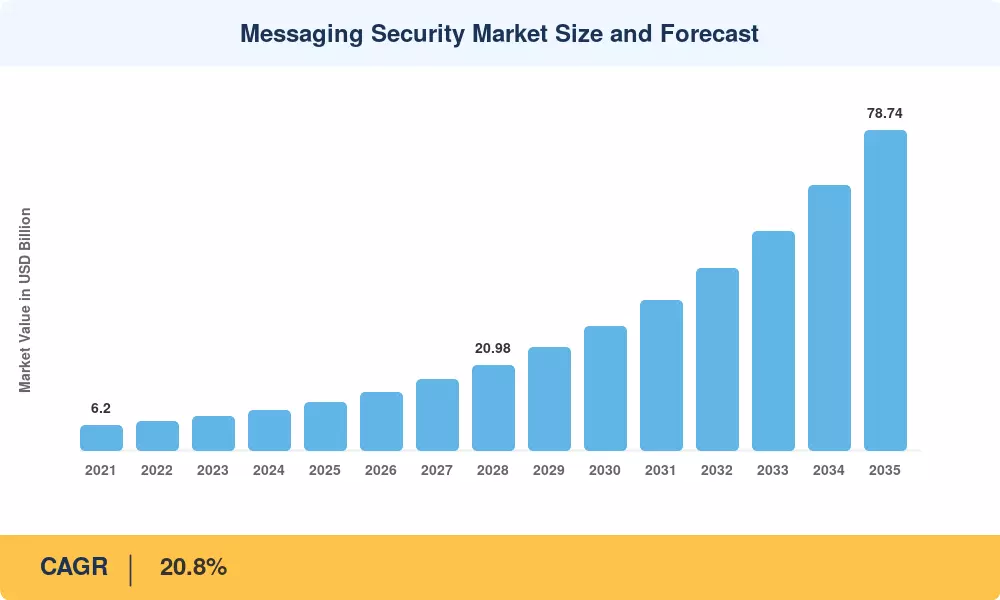
The global Messaging Security Market reached USD 11.90 Billion in 2025 and is projected to grow from USD 14.38 Billion in 2026 to USD 78.74 Billion by 2035, registering a 20.8% CAGR during 2026–2035. Escalating phishing and business email compromise attacks, cloud adoption, and regulatory requirements are pushing secure messaging into enterprise risk and governance priorities.
North America leads with approximately 38% market share, while Asia-Pacific is the fastest-growing region at a projected 24.3% CAGR. Email remains the largest security channel, but SMS security is expanding more rapidly as smishing attacks increasingly target mobile banking, authentication codes, and digital transactions.
Get a Sample PDF of the Report at -
https://www.marketresearchfuture.com/sample_request/4219
Market Dynamics: Drivers, Restraints and Opportunities:
Phishing, business email compromise, malicious attachments, and account impersonation remain central demand drivers. Attackers are using automation and generative AI to create more convincing campaigns, encouraging enterprises to adopt behavioral analysis, identity-aware detection, URL rewriting, sandboxing, and continuous remediation. Cloud and SaaS adoption has further increased the need for API-based protection across Microsoft 365, Google Workspace, and collaboration platforms.
Regulatory pressure is reinforcing investment. GDPR, CCPA, India’s DPDP Act, sector-specific rules, and national cybersecurity strategies require stronger protection, retention controls, and evidence of secure communications. Financial institutions remain the leading end-user segment because they face high attack frequency and stringent oversight. Government is the second-largest segment and is among the fastest-growing.
The category nevertheless faces adoption friction from false positives, integration complexity, budget constraints, and the need to coordinate messaging tools with identity providers, endpoint platforms, SIEM environments, and security-awareness programs. On-premises deployment also remains relevant for defence, intelligence, healthcare, and other organisations where sovereignty rules restrict data from leaving their controlled environments.
Opportunities include AI-powered real-time threat intelligence, managed services for SMEs, protection for mobile-first workforces, and monetisation of high-quality threat data. SMS security is projected to grow at 23.6% CAGR, while Asia-Pacific’s rapid digitisation creates a large addressable base for cloud-managed email and mobile messaging protection.
Key Players and Competitive Insights:
The competitive landscape has low concentration, with an estimated HHI below 800 and the top five vendors holding approximately 32% of global revenue. Leading companies include Cisco Systems, Proofpoint, Broadcom, Trend Micro, Mimecast, Microsoft, Barracuda Networks, Forcepoint, Sophos, and Check Point Software. Vendors compete on detection accuracy, false-positive rates, threat intelligence, remediation, and integration depth.
Buy this Premium Research Report at –
https://www.marketresearchfuture.com/checkout?currency=one_user-USD&report_id=4219
Recent Developments:
Barracuda Networks (June 2026): Launched Integrated Email Protection for automated detection and remediation across Microsoft 365 and Google Workspace.
SailPoint (June 2026): Completed the acquisition of Entro Security for approximately USD 200 million, adding non-human identity protection technology.
Cisco Systems (June 2026): Announced its intent to acquire WideField Security to strengthen identity-threat detection and Agentic SOC capabilities within Splunk.
Market Segmentations
By Deployment Type
• Cloud
• On-Premise
By Type
• SMS
By End-User Industry
• BFSI
• Government
• Healthcare
• Media & Entertainment
• Retail & E-Commerce
• Manufacturing
• Education
• Other Industries
By Region
• North America
• Europe
• Asia-Pacific
• South America
• Middle East & Africa
Regional Insights
North America holds approximately 38% share. The United States accounts for around 78% of regional spending, supported by federal zero-trust initiatives and requirements for DMARC, DKIM, and SPF.
Europe reached USD 3.21 Billion in 2025. GDPR, NIS2, sovereign-cloud infrastructure, and security requirements across regulated industries support demand.
Asia-Pacific is projected to expand at 24.3% CAGR during 2026–2035, driven by digital transformation, cloud adoption, and mobile-first workforce security.
South America holds roughly 7% share, while Middle East & Africa reached USD 0.71 Billion in 2025 as national cybersecurity programs and critical-infrastructure protection expand.
Browse A Full Report: (Including Full TOC, List Of Tables & Figures, and Chart) -
https://www.marketresearchfuture.com/reports/messaging-security-market-4219
Frequently Asked Questions (FAQs):
Q1. What is the expected growth of the Messaging Security Market?
The market is projected to rise from USD 14.38 Billion in 2026 to USD 78.74 Billion by 2035 at a 20.8% CAGR.
Q2. What factors are driving the market?
Phishing, business email compromise, cloud and SaaS adoption, regulatory mandates, and AI-powered threat intelligence are major growth drivers.
Q3. Which region leads the market?
North America leads with approximately 38% of global revenue, supported by mature cybersecurity spending and federal security requirements.
Q4. Which region is growing fastest?
Asia-Pacific is projected to grow at 24.3% CAGR during 2026–2035.
Q5. Which type is expanding fastest?
SMS security is forecast to grow at 23.6% CAGR, reflecting escalating smishing attacks.
Q6. Who are the leading companies?
Leading vendors include Cisco Systems, Proofpoint, Broadcom, Trend Micro, Mimecast, Microsoft, and Barracuda Networks.
➤➤ Regional & Country-Level Reports by Market Research Future:
GCC Messaging Security Market -
https://www.marketresearchfuture.com/reports/gcc-messaging-security-market-60673
Germany Messaging Security Market -
https://www.marketresearchfuture.com/reports/germany-messaging-security-market-60671
India Messaging Security Market -
https://www.marketresearchfuture.com/reports/india-messaging-security-market-60674
Japan Messaging Security Market -
https://www.marketresearchfuture.com/reports/japan-messaging-security-market-60672
South Korea Messaging Security Market -
https://www.marketresearchfuture.com/reports/south-korea-messaging-security-market-60670
Spain Messaging Security Market -
https://www.marketresearchfuture.com/reports/spain-messaging-security-market-60675
US Messaging Security Market -
https://www.marketresearchfuture.com/reports/us-messaging-security-market-14357
➤ Featured Insights from Market Research Future:
Online Video Platform Market -
https://www.marketresearchfuture.com/reports/online-video-platform-market-29550
Productivity Management Software Market -
https://www.marketresearchfuture.com/reports/productivity-management-software-market-29592
Shed Design Software Market -
https://www.marketresearchfuture.com/reports/shed-design-software-market-29614
Application Integration Market -
https://www.marketresearchfuture.com/reports/application-integration-market-29869
Market Research Future
Market Research Future
+1 855-661-4441
email us here
Legal Disclaimer:
EIN Presswire provides this news content "as is" without warranty of any kind. We do not accept any responsibility or liability for the accuracy, content, images, videos, licenses, completeness, legality, or reliability of the information contained in this article. If you have any complaints or copyright issues related to this article, kindly contact the author above.
